HR Consultant: How Expert HR Advisory Drives Business Growth
HR consultant has become one of the most decisive factors separating organizations that thrive from those that merely survive. As markets shift, technology accelerates, and workforce expectations evolve, leaders can no longer treat HR consultant as a secondary concern. Understanding HR consultant clearly, and acting on it with discipline, allows a company to build resilience, attract the right people, and sustain growth over time. This article breaks down what HR consultant really means, why it matters for modern organizations, the practical steps to apply it, and the questions leaders most often ask, so you can move from theory to measurable impact with confidence.
What Is HR consultant?
At its core, HR consultant describes the deliberate effort to align people, capability, and practice with where an organization is heading. It is less about a single program and more about a consistent way of working. When defined well, HR consultant gives teams a shared language and a clear standard to aim for, reducing the ambiguity that so often slows decisions.
It helps to distinguish HR consultant from the activities people sometimes confuse it with. It is not a one-off workshop, a software purchase, or an annual ritual. Instead, HR advisory services Indonesia is an ongoing capability that an organization builds and refines over time, informed by evidence and adjusted as conditions change.
Seen this way, HR consultant becomes a lens for decision-making rather than a box to tick. Leaders who internalize this definition tend to ask sharper questions, invest more wisely, and avoid the trap of treating symptoms while ignoring root causes.
Why HR consultant Matters for Modern Organizations
The business case for HR consultant rests on a simple truth: capability and culture compound. Small, consistent investments create outsized advantages over time, while neglect quietly erodes performance until the cost becomes impossible to ignore.
In the Indonesian market in particular, where competition for skilled talent is intense and customer expectations keep rising, the organizations that take HR consultant seriously tend to pull ahead. They retain their best people, adapt faster to change, and build reputations that attract both talent and customers.
There is also a cost to inaction that rarely appears on any balance sheet. Disengagement, avoidable turnover, slow decisions, and missed opportunities all quietly drain value. Viewed honestly, investing in HR consultant is often less expensive than the slow erosion that comes from ignoring it.
- Stronger retention and engagement, because people see a clear path to grow
- Faster, better talent decisions grounded in evidence rather than guesswork
- Greater resilience when markets, technology, or strategy shift
- A clear edge in attracting the talent every competitor is chasing
The Key Elements of HR consultant
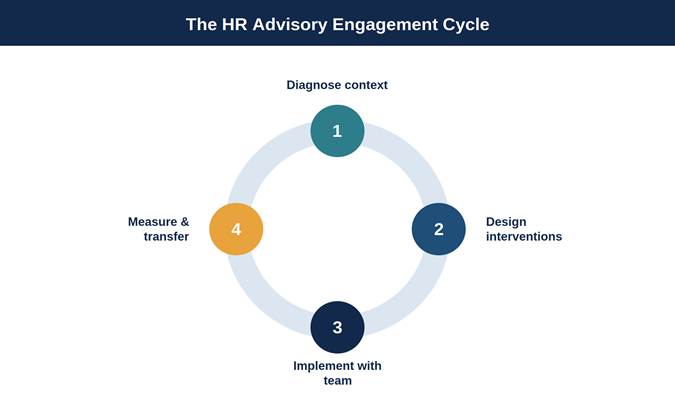
To put HR consultant into practice well, it helps to understand the elements that make it work. In most organizations these include Diagnose context; Design interventions; Implement with team, and Measure & transfer. None of them operates in isolation; their strength comes from how they reinforce one another.
Treating these elements as a connected system, rather than a checklist, is what separates organizations that see real change from those that run isolated initiatives. Each element should be designed with the others in mind, and reviewed together as the organization learns what works in its specific context.
It is also worth remembering that HR consultant is not static. The right balance of these elements shifts as the company grows, as the market changes, and as the workforce itself evolves. Periodic review keeps the approach relevant instead of letting it calcify into yesterday’s answer to today’s questions.
In practice, many organizations find that the biggest gains come when they stop treating these elements separately and start managing them as a single, coherent whole. That shift in perspective, from pieces to system, is often the most decisive turning point in the journey of applying HR consultant.
How to Apply HR consultant in Practice
Turning HR consultant into results requires structure. The approach below works across company sizes and industries, and can be adapted to your context with the help of AI in HR. The goal is not to follow steps mechanically, but to build a rhythm your organization can sustain.
Each step builds on the previous one. Skipping diagnosis, for instance, almost guarantees wasted effort later, because you end up solving the wrong problem with impressive speed.
The key to execution is consistency rather than perfection. It is better to run a simple cycle repeatedly and learn from each pass than to wait for a perfect plan that never quite begins. With every cycle, the organization gathers evidence, sharpens its understanding, and builds the confidence to go further.
A Step-by-Step Starting Point
Clarify the specific business outcome you want, in measurable terms
Assess where you are today using data, not assumptions or anecdotes
Prioritize the gaps that will deliver the highest impact first
Act on a focused plan, then measure and refine continuously
Common Pitfalls and How a Partner Helps
The most common mistake is treating HR consultant as a one-time event rather than an ongoing discipline. Momentum fades, attention moves elsewhere, and the early gains quietly reverse. Other frequent missteps include skipping honest diagnosis, ignoring measurement, and underestimating how much leadership behavior shapes whether change actually sticks. This is where an experienced partner adds value. Daya Dimensi Indonesia brings validated methods and decades of practice to help organizations apply HR consultant with rigor while keeping people at the center. A good partner does not create dependence; it transfers capability so that the impact outlasts the engagement and your own team grows stronger in the process.
Frequently Asked Questions